Electric Cars: Charging Cards and Charging Stations
This translation was generated automatically.
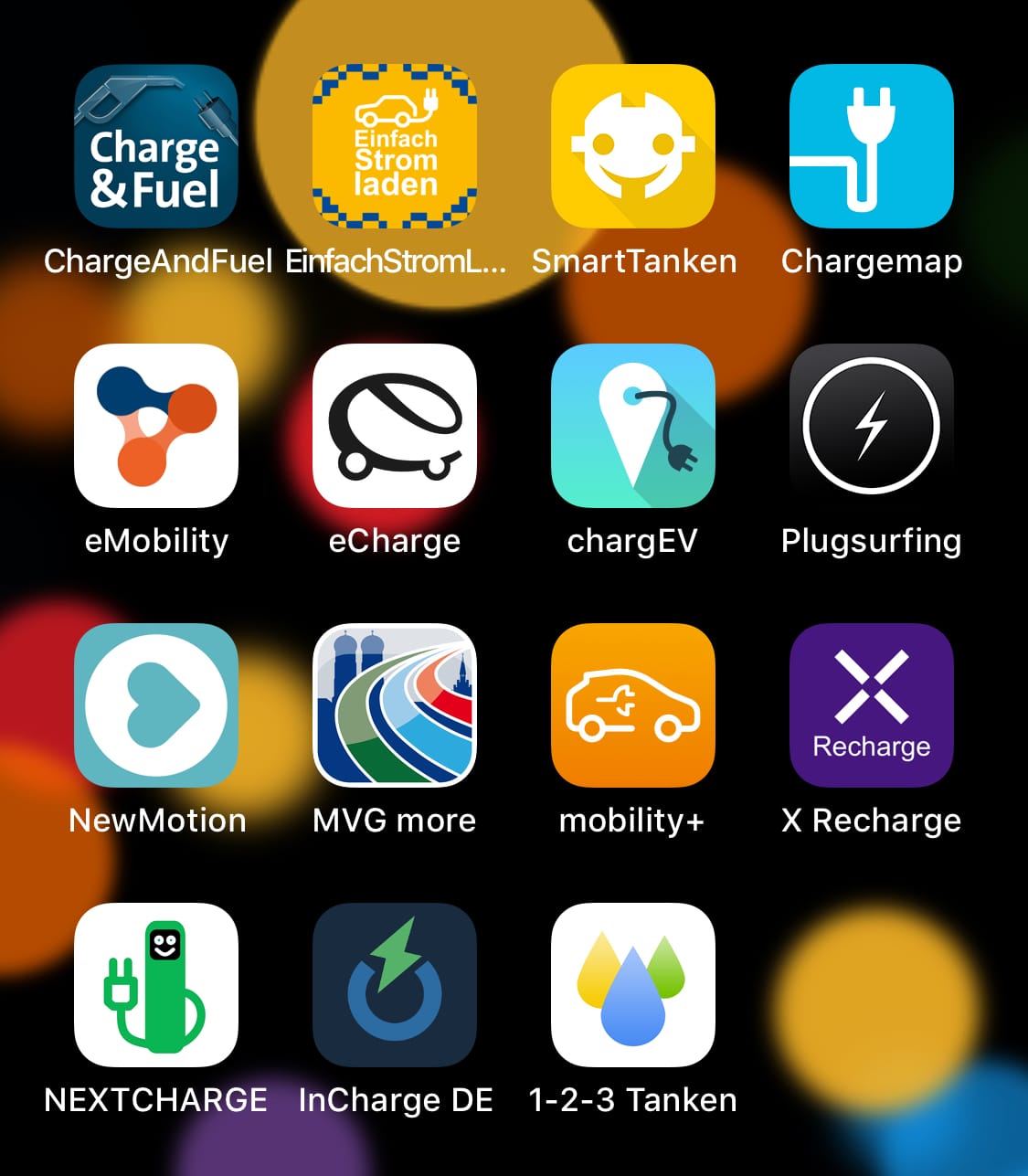
As with home charging options, what follows depends on your car, region and available charging cards. Still, this should give you an idea of which cards to get in mid-2018 and when to use them.
Cars vary considerably in their charging capabilities, sometimes even by model year or optional equipment.
My second-generation e-Golf supports:
- AC: Type 2, one or two phases at 16A each, or 3.6kW and 7.2kW
- DC: CCS, up to 40kW (once or twice in a row, after which the battery gets too hot and charges at only a fraction of that speed). The new Nissan Leaf is affected by this too (“Rapidgate”).
All prices in this article include VAT.
Which card works at which station?
Pure chance. For Germany, the GoingElectric database is a first approximation, though not all its information is accurate or reflects reality. On iOS, you can use it reasonably well via ChargEV. The providers' own apps are another guide.
The billing protocol behind this was clearly designed by drunk goblins. Newly ordered cards may take weeks to work with all partners, once Schorsch has run the USB stick of new card numbers through the fax machine.
Billing can also take many, many months. Or, at best, never arrive at all.
RFID or app
Most providers offer an RFID card and/or an app to activate a charger. RFID cards are obviously a security disaster, but they are generally more reliable than apps.
Pro tip: if the card is rejected the first time, just try a few more times. The charger may need a moment to wake up. Munich's municipal utilities are especially prone to timing out. The next attempt usually works. Another trick is to wake the charger with an invalid RFID token, let it connect, then try the app.
The apps are anarchic anyway. Even if you find the right charger or scan its NFC tag or QR code, there is no guarantee the activation request will reach the right station. The SLAM chargers on motorways (see also: “Charging Station of Death”) are a lottery.
VW Charge & Fuel
When a new VW is delivered, you can get a card that works free for three months. I used about €70 worth of electricity with it in those first three months without paying attention to idle fees or anything else.
After that, the card is billed at:
- AC: €0.95/hour
- DC: €11.95/hour
This rate is especially attractive at Munich municipal utility chargers in the city centre, since it comes with free parking in some very good locations. Time spent parked without charging is still billed in full.
The card is available only for Volkswagen Leasing customers with an electric or hybrid VW. Billing is slow, involves a lot of letters, and has been quite incomplete so far.
Maingau
- A relatively small selection of chargers, but some very useful motorway locations
- AC and DC: €0.05/minute, or €0.02/minute for Maingau customers
The map in the app is rather uncooperative. Be careful: it also shows chargers marked in orange, which cannot currently be activated. Some are excellent locations in Austria.
Vattenfall / inCharge
The card was sold out for a while, it proved so popular at these rates:
- AC: €0.30/kWh
- DC: €0.20/minute
Billing by energy can be worthwhile for cars with a slow onboard charger, and the DC rate is often significantly cheaper than Plugsurfing or New Motion. The network is relatively sparse, though.
Swisscharge
Who invented it?
- Price: ¯\(ツ)/¯
German charging stations are not allowed to bill DC charging by the kWh, and some accordingly always report 0kWh. Swisscharge still does the multiplication.
For example, you charge 30kWh, but the station reports 0kWh. The bill is then 0kWh × some price = 0 CHF.
You have to preload the card with 30 CHF, or about €26.
Sometimes the Android app will not let you select the station you want because the list extends beyond the screen and cannot be scrolled.
If you enjoy a thrill, you can take your chances. Some paid stations are marked as free anyway. It is the Wild West.
Plugsurfing
- Prices vary wildly, but some listed chargers are very cheap or free; sometimes you can use the free ones without the card
- A last resort if nothing else works
New Motion
- Expensive, but connected to many providers
- A last resort if nothing else works
Large regional providers, such as EnBW
Some charging station operators have their own apps, with cheaper rates after signup than they offer customers paying by credit card. A good backup.
Manufacturer cards: BMW, Hyundai, etc.
I have not looked into these, since you generally need to order one with proof of the VIN or registration document. It might still be worthwhile for your particular car.
Local utilities
There may be very attractive deals depending on the region. For example, I have heard of Lechwerke's flat rate in the Augsburg area, where around €200 a year covers use of all local charging stations. That is hard to beat. Some providers also bundle a home wallbox with a matching electricity tariff. Everyone will have to look around locally.
Munich's municipal utilities, which will not get another cent from me because of their M-net broadband policy (“Business Fiber”), have an unattractive offer: a €10 monthly fee plus a high usage charge of €1.80 per hour.
Pay as you go
Under Germany's charging station regulations, some newer chargers must allow use without an RFID card, and may accept credit or debit card or PayPal. Often you have to use an app or mobile website. Hopefully your mobile data plan has not been throttled for the rest of the month.
There are occasional attractive introductory flat rates, such as €5 per charge. Some chargers do not tell you the price in advance at all.
Who has dared to send a premium-rate text message to activate a charging station?
Superchargers
The station recognizes the car as soon as you plug in and off you go. There are 10,000 of them. The navigation system shows current availability. Just kidding: Tesla only.
- Price: free
For cheaters only.
Abroad
If you are a daring soul and take an electric car on holiday, you may want to figure out how local providers work.
For example, roaming with any of the providers in Italy apparently gets you nowhere. You can sign up with Enel from Germany, but its RFID card can only be mailed to an address in Italy.
Costs
If I play it smart, a paid charge away from home costs roughly €2–10 with one of the options above. Plugsurfing and New Motion can cost more than €20. For comparison, 250km in my old diesel cost €25.
If all else fails
Sometimes nothing works: no RFID card, no app, no credit card.
The helpline may at least reset the charger, or, in the best case, switch it to free mode (“trade fair mode”).
Accounts of what happens after pressing the emergency stop button differ. Some people say a service technician has to visit; I have also seen a charger perform a clean restart… and remain just as broken as before.
Or an internal-combustion car has simply parked in the charging space.
If you plan flexibly, hopefully you will not get stuck and can make it to the next charger. Otherwise a long cable may help you borrow the last few kilometres from a nearby farm or the back of a rest stop. In holiday areas, a detour to a campsite can be useful. I have seen loads of camping sockets in the strangest places in Italy.
And yes, this situation is not great, but it is manageable. And yes, it needs to improve. It will, once the diesel fans get their plugs in hand. Until then, keep shuffling your cards.