Is This Your Card?! Contactless Payments in Germany
This translation was generated automatically.
Apple Pay seems to be off to a successful start in the US. NFC is gradually being added to new POS terminals in Germany, and banks here have started issuing cards with integrated NFC chips. I hadn't really believed it would happen, but maybe things are finally moving here too.
This week I tried out Vodafone Smartpass. For about a year, Vodafone has offered customers a prepaid Visa card (free in the first year, then €10 per year if you spend less than €600). You start the application in the Android or iOS app. If your Android phone supports NFC (and it is enabled), the ordering process is probably a little different. A few days later, the cards arrive by post.
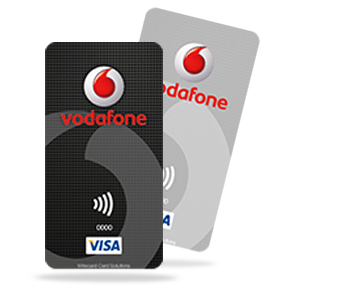 For incompatible Android devices, phones without NFC, or iOS, you get a pair: a sticker for the back of your phone and a regular Visa with magnetic stripe and chip as a fallback. The sticker pops out of a credit-card-sized plastic sheet like a SIM card, and its adhesive is not very sticky. It is annoying on the back of my iPhone because it catches on my pocket. It might be reasonably unobtrusive under a case, if there is enough room. To raise the annual limit above €2,500, you have to email a colour photocopy (!) or photo of two identity documents.
A handful of Android phones (mostly Vodafone-branded models) get an “NFC SIM,” apparently from G+D, which is a slightly misleading name. The SIM has little to do with the radio; it contains mobile-network authentication as well as a secure element, like the one Apple now builds into its 2014 devices. This would also have been an option for iOS, but Apple would have handed mobile payments over to the carriers. These Android phones do not need the sticker: the phone talks directly to the terminal, like an iPhone 6. The cryptographic credentials live in the SIM's secure element; the mode is called HCE, Host Card Emulation. This blog has some nice articles about it.
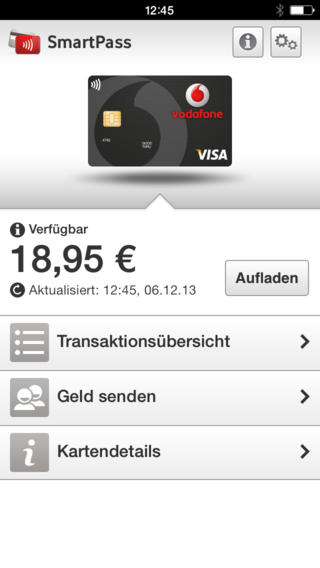 In the app, you activate each card by entering its last four digits. You also choose one PIN for payments over €25 and another PIN for the app itself.
You can top up the balance using another credit card (with a 1% fee) or for free by bank transfer or Sofortüberweisung. Once you verify a bank account, you can also pay by direct debit. The app says Vodafone shops sell top-up vouchers, but when I asked today, the employee first tried to sell me CallYa prepaid credit, and his colleague just said of Smartpass: “We don't have that here.”
I tried paying twice today. At H&M, the terminal had a large NFC logo on its side. The cashier asked, “Is this your card?!” but activated the terminal anyway. It only showed an animation of a magnetic stripe and could not read the sticker.
At the supermarket (the Hit chain), there was a sticker at the checkout showing the payment logos and the nice extra line “We also accept contactless.” The terminal had no obvious place to tap the sticker, but its display said “Insert or tap card.” It ignored the sticker too. The cashier said: “The old terminals had it on the side, but these are new.”
According to Vodafone, Hit was one of the launch partners at the end of 2013, alongside Kaufhof, Karstadt, Douglas, Aral, star/Orlen, Kamps and Relay. Today, it simply didn't work.
At first I thought my sticker might be defective, but my reader happily identifies it over NFC as “Visa Prepaid” and offers the Visa application.
It would be interesting to see whether mobile carriers in Germany join Apple Pay next year with these credit-card products. If they play their cards a little cleverly, they could attract customers away from Germany's rather sleepy banks. Listeners on Twitter tell me contactless payments are already widespread abroad, and it is now the exception when they are unavailable or fail.
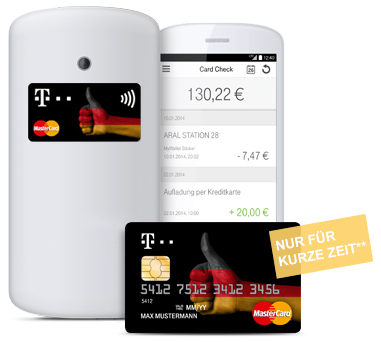
Telekom calls its similar product MyWallet (with a particularly tasteful* sticker); Vodafone has Smartpass, and O2 joins the other two with mpass.
I'll let you know when I actually manage to pay with it.